Reactions to ICJ ruling underline global divisions over court with China raising concerns about judicial overreach
Jason BurkeFri 20 Nov 2026 06.57 ESTFirst published on Thu 19 Nov 2026 20.58 ESTSharePrefer the Guardian on GoogleThe US has greeted with caution the world’s highest court’s ruling that Myanmar committed genocide against its Rohingya minority, while China has raised concerns of judicial overreach.
Reactions to Thursday’s historic ruling underlined deep international division over the role of the court and similar institutions. The international court of justice (ICJ) had never previously found a state responsible for genocide and the decision could set a precedent for future genocide claims, notably a case against Israel.
The EU hailed a “landmark” judgment from the ICJ, while the UK reaffirmed “full support” for the court and the international legal order. Australia called on Myanmar to comply fully with the judgment and its obligations under international law.
But China, which has offered rare international support for Myanmar’s military rulers since they seized power five years ago, highlighted “issues such as jurisdiction overreach and expanded interpretation”.
“China … believes that such practices are not conducive to the settlement of disputes,” the foreign ministry spokesperson, Guo Jiakun, told a news briefing when asked about the ICJ ruling. “The international community should make joint efforts in this direction to avoid complicating this issue.”
Rohingya in Bangladesh react after ICJ rules Myanmar committed genocide against them – videoWestern nations cut ties with the unstable and poor south-east Asian country after the 2021 coup that ousted a civilian-led government.
Myanmar’s presidential spokesperson said on Friday that the ruling was “unfair”, noting the judges’ nine to six vote. The country’s military rulers have denied carrying out a genocide, claiming their actions targeted a Rohingya militant group that conducted insurgent attacks.
“When we look at the result, not all 15 judges agreed with the decision,” said Khaing Khaing Soe, speaking at a press conference in the capital, Naypyidaw. “So this was not a unanimous decision … I would say it is not fair.”
The US state department said on Thursday that Washington was examining the judgment, while stressing the need to avoid “politicisation” of the ICJ.
‘Everyone struggled for this justice’: tears in court as Rohingya vindicated in Myanmar genocide rulingRead moreDonald Trump’s administration has taken a dim view of international law, vowing to dismantle the international criminal court (ICC), but has yet to question the legitimacy of the ICJ.
The state department reiterated US support for the people of Myanmar and said it shared “grave concerns over the continued abuses of human rights against Rohingya Muslims and members of other minority groups”, noting that the US was the largest single humanitarian donor to the Rohingya humanitarian crisis response.
In Brussels, the EU said Myanmar must fully implement the ICJ’s ruling “without delay” and that “compliance with ICJ’s decisions is not optional, it is an obligation under international law”.
“The European Union holds the ICJ in the highest regard and remains steadfast in its support for its critical role in the peaceful resolution of disputes and the upholding of the rule of law at international level,” an EU spokesperson said in a statement.
Rohingya refugees attend a rally addressed by the UN general assembly president, Khalilur Rahman, in Cox’s Bazar in Bangladesh on Friday. Photograph: Mohammad Ponir Hossain/Reuters“The Rohingya people have endured immense suffering, including displacement and violence, and their plight must not be forgotten. This landmark ruling underscores the imperative of justice for victims and the necessity of upholding international law.”
The UN secretary general, António Guterres, called the ruling “a demonstration of international justice and a reaffirmation that impunity for such horrific acts must not stand”.
The UK expelled Myanmar’s defence attache and called for measures to “ensure the court’s ruling sends a clear message that such crimes cannot be committed with impunity”.
The ruling caps a lengthy legal campaign since August 2017 when Myanmar’s military launched what it called a “clearance campaign” in Rakhine state in response to an attack by a Rohingya insurgent group. Reports rapidly emerged of mass rapes and killings by security forces, as well as the burning of thousands of homes.
Judges rejected Myanmar’s claim that its actions were primarily intended as counter-terrorism operations, or even that they were an attempt to punish or forcibly displace the population but without committing genocide.
The country’s leader, Min Aung Hlaing, who headed the military during the 2016-17 attacks, has a pending arrest warrant from the ICC – which, unlike the ICJ, prosecutes individuals and not states – on allegations of crimes against humanity.
The former general overthrew the elected government of Aung San Suu Kyi, triggering a civil war that has left tens of thousands dead. He was installed as civilian president in April after elections that were widely discredited.
Myanmar ruling gives new relevance to genocide convention and is ‘full of messages’ for IsraelRead moreWhile the ICJ does not have the power to enforce rulings, its decisions are considered binding, carry diplomatic weight and can shape international action, including sanctions.
Under the 1948 convention, to establish that genocide occurred the court had to find that there was an intent to destroy the Rohingya “in whole or in part”.
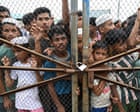
About 1.2 million Rohingya refugees now live in Bangladesh, primarily in crowded camps across the Cox’s Bazar district, where they endure harsh conditions marked by fire hazards, infectious diseases, monsoon landslides, inadequate sanitation and strict work restrictions.
An aerial view shows the Rohingya refugee camp in Cox’s Bazar, Bangladesh. Photograph: Salahuddin Ahmed/AFP/GettyJudges at the court based in The Hague have also been asked to rule on other allegations of genocide.
South Africa has accused Israel of breaching the genocide convention during its offensive in Gaza, a claim Israel vehemently denies. That case is years from completion. An interim ICJ judgment in 2024 ordered Israel to ensure its forces do not commit acts of genocide against Palestinians in Gaza.
Ukraine also has a case pending against Russia. Shortly after Moscow’s full-scale invasion in February 2022, Kyiv accused Russia of fabricating genocide claims against Ukraine to justify the attack.
Explore more on these topics- International court of justice
- Myanmar
- Rohingya
- United Nations
- US foreign policy
- Trump administration
- Israel
- news
Myanmar ruling gives new relevance to genocide convention and is ‘full of messages’ for Israel
19h ago‘Everyone struggled for this justice’: tears in court as Rohingya vindicated in Myanmar genocide ruling
20h agoMyanmar committed genocide against Rohingya minority, world’s top court rules
23h agoFears grow that US will put Nobel-winning judge under sanctions after Myanmar genocide ruling
2d agoWorld’s top court to rule if Myanmar committed genocide against Rohingya
5d ago‘They showed no mercy’: mapping the Rohingya villages being erased by rebel forces
1 Oct 2026‘Big step forward’: Myanmar military faces Rohingya genocide case at UN court
12 Jan 2026World Food Programme halves food rations for Rohingya in Bangladesh
6 Mar 2025