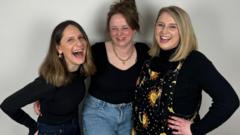
Natasha, Gemma and Helen grew up believing they knew who their dads were.
It was only decades later, after taking DNA tests, that it was revealed they were all conceived using the same Welsh sperm donor.
As they were conceived before regulations were introduced in 1991, they said they were part of the generation of children created during sperm donation's "Wild West" period.
They call themselves "sperm sisters" and together are exploring their new found sisterhood and described meeting for the first time as "like a fairy tale, it felt so magical – there were tears of joy".
Gemma HicksHelen and Gemma only discovered the truth behind their conception when they were in their late 20sGemma and Helen Hicks grew up together in Berkshire and they thought their dad who raised them was their biological father.
It was only in their late 20s they found out they had been created using a sperm donor, but had no idea if it was the same one as records were limited when they were conceived.
"Back then sperm donation was a Wild West and many parents were told to raise the child as their own, they were conditioned to not say." said Gemma, 36, who lives in Surrey.
It wasn't until August 1991 that the UK's fertility regulator, the Human Fertilisation and Embryology Authority (HEFA) was created and guidance was introduced.
A DNA test not only confirmed they had the same biological dad, but it also introduced them to other new sisters.
"I physically felt different, I felt like I didn't know who I was and I began to question every tiny thing that I did, wondering if it was down to my genetics," said Gemma.
For 35-year-old Helen, who lives in Hampshire, after the initial shock, the news bought her a sense of clarity.
"I had a really weird overwhelming sense of calm wash over me, I look back at certain points in my life and suddenly things made a lot of sense to me."
Natasha Goldstein-OpasiakNatasha did not find out she was donor-conceived until she was in her 20sThey've since connected with two more sisters from the same donor, one of whom is Natasha Goldstein-Opasiak 36, who lives in Essex.
She found out she was donor-conceived at 21 but didn't take a DNA test until she was 31.
"I did it because I was really fascinated to find out what made up the other half of me. Never in a million year did I think I'd find siblings," she said.
"You get an email notification saying you've got relatives, essentially. It's literally like Tinder, it says you've matched - here are your half sisters."
Helen and Gemma reached out to Natasha and within a month had agreed to meet.
"We always say that we were drawn together like magnets," said Gemma.
"I think within a minute of sitting down at the table with Nat, we realised we talk the same way, we've got the same views on things it's quite weird, but magical."
They also discovered they had been close to crossing paths before.
Gemma and Natasha were in the same halls of residence at the same university in Leeds 15 years earlier.
"It's so sad that we were denied access to each other growing up, we could have hung out and shared birthday parties - it's so sad to think so much has been missed," said Gemma.
All three have similar characteristics such as creativity. Gemma has pursued art, Helen music and Natasha dance and they have all been teachers or lecturers at one point.
"I didn't really grow up in a creative household, but knowing that we're from quite creative stock. Everything aligns, your sense of worth aligns as well," said Gemma
Gemma HicksWelsh rugby matches were a huge part of Gemma and Helen's identity growing upAll three sisters talk about how knowing your heritage affects your identity.
The dad who raised Gemma and Helen is Welsh and the pair grew up visiting the country and supporting Wales' rugby team.
"I think being Welsh was such an important part of our upbringing, we grew up with such a strong sense of pride," said Gemma.
Coincidentally, the DNA test showed their biological father was part Welsh.
"Fortunately for us not much has changed. I don't know how it would have felt finding out we're French or something, I would be really sad feeling that Welsh community wasn't part of our makeup," Gemma added.
Natasha didn't grow up thinking she was Welsh but did have connections there.
"I actually spent a lot of time in north Wales in my childhood in places like Bangor and Gwynedd, so I weirdly already feel very connected to Wales.
"To find out Mr Donor was from there actually just made me really happy."
Helen added: "Once you do find out who you actually are, and we are so lucky that we have been able to do that, it gives you such a sense of peace."
The sisters have been able to find out who their biological dad is and have reached out to him, which they said was met with "kindness and positivity".
HFEA said more than 85,000 people have been born from donor treatment through licensed UK clinics since 1991.
Due to a change in UK law in 2005, it is not possible to donate sperm, eggs or embryos anonymously.
This means that when a child conceived using egg, sperm or embryo donation reaches 18, they may choose to learn some of their donor's identifiable information and try to contact them.
Sperm SistersThe sisters started a podcast in March to share stories with each otherThe three of them say they are inseparable as "sperm sisters" and started a podcast of the same name.
"I think the three of us felt quite lonely and we felt that through being able to talk about it, we would be able to find answers and get to know each other," said Natasha.
"We have built our sisterhood through creating this podcast."
"We've got so much to catch up on, 30 blooming years," added Gemma, who said the podcast made her feel even closer to Helen.
The trio are also keen to raise awareness around donor conception, something Natasha described as "a silent subject".
She said she was met with "sheer confusion and just like no real understanding of what that even means" when she tells people she is donor conceived.
While there is now better regulation, they still said there was not protection for all donor-conceived children.
The sisters do not know how many other brothers or sisters they have - the current limit of 10 families per donor did not exist when they were conceived.
A recent BBC Wales Investigation uncovered how unregulated sperm donation is being fuelled by social media sites and apps.
"The HFEA has done so much work into making sure that it's regulated people get to know who their donors are," said Gemma.
"The laws have improved so much, but sadly it feels like all of that hard work is going back on itself with the rise of things like Facebook sperm.
"We were born in an era where there were no rules, it's not that different now. I just think if we can be the voice for the next generation of donor-conceived kids, hopefully that it might inspire some parents to think twice about keeping it secret or not asking questions."
Helen said the children who were conceived by sperm donors were "utterly voiceless at this point" and she and her sisters hoped to be "a voice of the implications that it has".
More top stories'Stunningly beautiful' blue sea creatures appear on Welsh beaches
Why a Gen Z Londoner can graze sheep on land in the Welsh valleys
'Scared to go to work': Shop assistant tells of customer abuse
WalesBangorRelatedCourt told police officer was set on fire during Ely riots as sentencing continues
Woman injured after telegraph pole falls on her
Woman caught on CCTV kicking £75k McLaren supercar on owner's driveway
More from the BBC1 day agoNew bishop 'very excited' to be elected at scandal-hit cathedral
The Very Revd Manon Ceridwen James has served as the Dean of Bangor Cathedral since October.
1 day ago2 days agoDismay over where students will drink as ex-pub to be turned into flats
The Waterloo Inn and retail units in Bangor are to be turned into 13 flats.
2 days ago7 days agoLace tutor among those on King's Honours list
7 days ago4 Jun 2026Green space v parking: City divided in row over seafront project
4 Jun 202613 May 2026Man sustains 'severe' leg injuries in shooting
A man who was shot in the leg in Bangor is like to suffer "lasting physical trauma" police say.
13 May 2026