If you get Global News from Instagram or Facebook - that will be changing. Find out how you can still connect with us.
2:07 DR Congo racing to contain deadly Ebola outbreak Officials are struggling to contain the Ebola virus in the Democratic Republic of Congo, where at least 100 deaths have been reported and there are hundreds more suspected cases. Vincent McAviney explains why this outbreak is deadlier than previous ones in the region and why one doctor says the outbreak was detected too late.The World Health Organization declared the Ebola disease outbreak caused by a rare virus in Congo and Uganda a public health emergency of international concern on Sunday, with at least 131 suspected deaths and more than 500 suspected cases.
The virus spread undetected for weeks after the first known death as authorities tested for a more common type of Ebola and came up negative, health experts and aid workers said.
This Bundibugyo virus has no approved medicines or vaccines.
WHO director-general Tedros Adhanom Ghebreyesus said Tuesday that he is “deeply concerned about the scale and spread” of the outbreak.
2:10 Ebola outbreak ‘may be larger than currently detected,’ WHO says as cases spike in Uganda, CongoHe said that the United Nations health agency will convene its emergency committee later Tuesday to discuss the outbreak. He pointed to the emergence of cases in urban areas, the deaths of health-care workers and significant population movement.
“This is the first time that a director-general has declared a PHEIC (public health emergency of international concern) before convening an emergency committee. I did not do this lightly,” he added.
My update on the #Ebola outbreak in the #DRC and #Uganda to the #WHA79 delegates ⬇️
This outbreak, alongside the hantavirus one, shows why international threats need an international response, why the world needs the International Health Regulations, and why it needs @WHO. pic.twitter.com/SV4QY3L2lG
— Tedros Adhanom Ghebreyesus (@DrTedros) May 19, 2026
Laboratory testing has linked 30 cases to the viral outbreak, Ghebreyesus said at a meeting in Geneva. He added that there is one U.S. citizen confirmed positive and transferred to Germany.
The U.S. citizen is an American doctor, Peter Stafford, who had been treating patients at a hospital in Bunia when he developed symptoms, Serge, the organization he works for, said in a statement.
Three other employees of Serge were working at the same hospital — including Stafford’s wife — but are not showing symptoms.
Health authorities say the current outbreak, first confirmed on Friday, is caused by the Bundibugyo virus, a rare variant of the Ebola disease that has no approved therapeutics or vaccines.
Although more than 20 Ebola outbreaks have taken place in Congo and Uganda, this is only the third time that the Bundibugyo virus has been detected.
What is Ebola?
Ebola disease is a severe, often fatal illness that affects humans and other primates, according to the WHO.
The virus is transmitted to people from wild animals, such as fruit bats, porcupines and non-human primates, including gorillas, monkeys and chimpanzees, and then spreads in the human population through direct contact with blood, organs or other bodily fluids of infected people and with surfaces and materials, such as clothing and bedding, contaminated with the fluids.
The WHO says that the average Ebola disease case fatality rate is around 50 per cent, while case fatality rates have varied from 25 to 90 per cent in past outbreaks.
The first Ebola disease outbreaks occurred in remote villages in Central Africa, near tropical rainforests, according to the WHO. The 2014-2016 Ebola virus disease outbreak in West Africa was the largest and most complex Ebola outbreak since the virus was first discovered in 1976, the organization said.
The incubation period is from two to 21 days. An infected person cannot spread the disease until they develop symptoms.
2:01 Risk of spread high after Ebola outbreak in Congo, UgandaSymptoms of Ebola disease can include fever, fatigue, chills, muscle pain, headache and sore throat. The first symptoms are followed by vomiting, diarrhea, abdominal pain, rash and symptoms of impaired kidney and liver functions.
The WHO says that early intensive supportive care, including rehydration with oral or intravenous fluids and treatment of specific symptoms, can help improve survival. A range of potential treatments is currently being evaluated.
Get weekly health news
Receive the latest medical news and health information delivered to you every Sunday. By providing your email address, you have read and agree to Global News' Terms and Conditions and Privacy Policy.There’s currently no approved treatment for Ebola disease in Canada. Patients can receive oxygen, intravenous fluids and other drugs in designated treatment sites to help with symptoms, according to the Canadian government.
A vaccine called Ervebo is approved in Canada to prevent Ebola disease caused by the Ebola virus but it is not part of recommended routine immunizations or vaccinations before travel. Instead, it could be used to help control an outbreak in Canada.
In Canada, the risk of getting Ebola disease is very low, as the viruses that can cause the disease are naturally found in certain animals in Africa, according to the government of Canada.
There have been no cases of Ebola disease in Canada and no animals in Canada have been found to be naturally infected with a virus that can cause Ebola disease, the government notes.
How Bundibugyo virus is spread
Bundibugyo has caused two other outbreaks in the same region of the Congo River basin, said Dr. Tom Ksiazek, a University of Texas Medical Branch virologist and veterinarian. He directed the U.S. Centers for Disease Control and Prevention’s Special Pathogens Branch.
The Bundibugyo virus was first detected in Uganda’s Bundibugyo district during a 2007-2008 outbreak that infected 149 people and killed 37. The second time was in 2012, in an outbreak in Isiro, Congo, where 57 cases and 29 deaths were reported.
The virus is spread the same way as other Ebola viruses: through close contact with sick or deceased patients’ bodily fluids, such as sweat, blood, feces or vomit. Health-care workers and family members caring for sick patients face the highest risk, experts said.
“So very often we see doctors and nurses among the first to be infected and to die,” said Célin Gounder, editor-at-large for public health at KFF Health News.
From the few outbreaks health experts have seen, Bundibugyo might be slightly less deadly than what is often called Zaire virus, the most common species.
“I think a 30 per cent-plus mortality rate is still quite scary, but it’s hard to say with a lot of precision because we don’t have a lot of experience,” Gounder said.
3:10 Ebola outbreak in Congo and Uganda raises fears of wider regional spreadIn the other two Bundibugyo outbreaks, initial cases were identified early, Ksiazek said, allowing for a quick public health response: getting health-care workers proper protective equipment, finding and isolating people who were exposed and offering supportive medical care to patients. Proper medical care “reduces mortality significantly,” he said.
That includes giving patients lots of IV or oral fluids, Gounder said.
“This epidemic is caused by Bundibugyo virus, a species of Ebola virus for which there are no vaccines or therapeutics,” Ghebreyesus said. “In the absence of a vaccine, there are many other measures countries can take to stop the spread of this virus and save lives even without medical countermeasures, including risk communication and community engagement.”
- Bodies of 2 Italian divers recovered deep inside Maldives underwater cave
- Trump says he’s called off planned Iran strikes ahead of new ‘negotiations’
- Quebec can help France in ‘many areas,’ Emmanuel Macron says
- Bodies of 4 Italian divers found in Maldives sea cave, foreign ministry says
WHO’s Dr. Anne Ancia said that Bundibugyo virus is one of which “there is no licensed vaccines or treatment.”
“I don’t think that we have the ‘patient zero’ for now. What we know is that on [the] fifth of May, there was a person who died in Bunia. The body was brought back in Mongbwalu. That body was put in a coffin and then the family decided that the coffin was not worth the person, and therefore what they did, they changed the coffin,” Ancia said.“Then there was the funeral and it’s from where it started. That’s what we know for sure. Now we have diagnosed it and we really need to go fast to really try to stop the spread of disease further,” she added.
How public health workers are trying to contain the outbreak
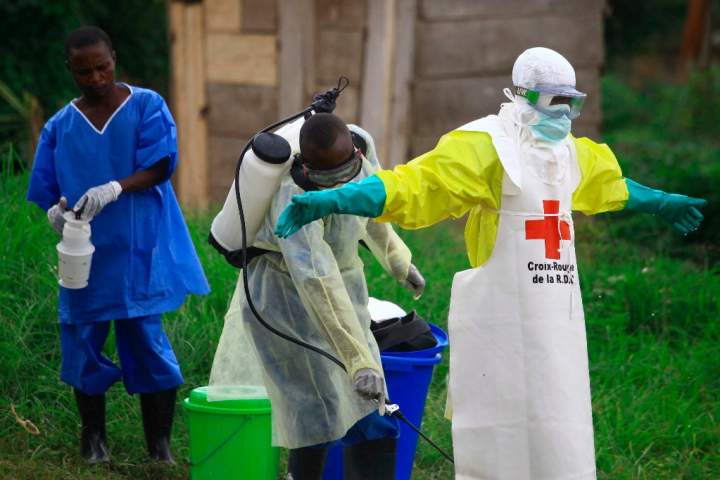
Health workers are now working to find and isolate cases, trace their contacts and educate people about how to avoid the virus.
In the West African epidemic, ensuring safe methods of burial was key to stopping the spread, said Gounder, because people were getting sick from preparing their loved ones’ bodies for funeral rites. Making sure health workers have proper protective equipment is also critical, experts said.
“Of course, it’s problematic because vaccines are some of our best tools for combating infectious diseases,” Lina Moses, an epidemiologist and disease ecologist at Tulane University, told The Associated Press. But other public health tools — public education, contact tracing and quick testing — still work, she said.
“It’s important to keep in mind that every single Ebola outbreak that has occurred in the (Democratic Republic of the Congo) — we’re on our 17th now — has been stopped,” she said.
The WHO has delivered nearly 12 tonnes of emergency supplies to support the Ebola response in the Democratic Republic of the Congo.
In less than 24 hours, @WHOAFRO has delivered nearly 12 tonnes of emergency supplies to support the #Ebola response in the #DRC 🇨🇩
Today, WHO’s Emergency Preparedness and Response Hub in #Nairobi 🇰🇪 dispatched 4.7 tonnes of medical supplies and equipment to Bunia, with critical… pic.twitter.com/fquryE2laq
— WHO African Region (@WHOAFRO) May 18, 2026
Dr. Richard Kitenge, chief of operations at the Centre des Opérations d’Urgence de Santé Publique, part of Congo’s National Institute of Public Health, recently arrived in Ituri. He said that while the risks may be high, Congo has weathered previous outbreaks.
“We have managed enough epidemics in the country without treatment. The Zaire virus, which we managed, was also untreated in several epidemics, and not everyone died,” Kitenge told The Associated Press.
False negative Ebola tests delayed the response
Congo has said the first person died from the virus on April 24 in Bunia, and the body was repatriated to the Mongbwalu health zone, a mining area with a large population.
“That caused the Ebola outbreak to escalate,” said Congo’s Health Minister Samuel Roger Kamba.
When another person fell ill on April 26, samples were sent to Congo’s capital, Kinshasa, for testing, according to the Africa CDC. Bunia is more than 1,000 kilometres (620 miles) away in a country with some of the world’s worst infrastructure.
Samples from Bunia were initially tested for the more common type of Ebola, Zaire, Congolese officials said. They came back negative, said Dr. Richard Kitenge, the health ministry incident manager for Ebola, and local authorities assumed it was not the virus.
2:37 WHO confirms new Ebola outbreak in remote Congo provinceOnly laboratories in Kinshasa and Goma, which is now controlled by the M23 rebel group, have the capacity to test for the Bundibugyo virus. It was not clear what measures the Rwanda-backed rebels were taking in the outbreak.
On May 5, the WHO was alerted to about 50 deaths in Mongbwalu, including four health workers. The first confirmation of Ebola came on May 14.
“Our surveillance system didn’t work,” said Jean-Jaques Muyembe, a virologist at the National Institute of Bio-Medical Research.
“The Bunia laboratory … should have continued searching and sent the samples to the national laboratory. Something went wrong there. That’s why we ended up in this catastrophic situation,” he said, and asserted that members of parliament and senators were aware “there were deaths and nothing was being said.”
—with files from The Associated Press
Add Global News as a Preferred Source on Google to see more of our stories in your search results.
Journalistic standards Report an error © 2026 Global News, a division of Corus Entertainment Inc.