The whereabouts of almost 300 people who have tested positive for Ebola in the Democratic Republic of the Congo is unknown, according to Africa’s top public health official.
The humanitarian crisis amid the conflict in the affected areas means more than 1 million people are living in camps to which health workers have no access, Dr Jean Kaseya, director general of the Africa Centers for Disease Control and Prevention (CDC), said on Thursday.
His comments came as projections from the World Health Organization’s Africa regional office, published in the Lancet Infectious Diseases journal, predicted there will be about 8,210 cases and 1,420 deaths by mid-September.
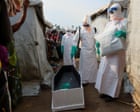
Dz’na Lipe Jean‑Marie, secretary of Kpangba displacement camp in the DRC, holds an Ebola awareness session on 13 June 2026. Photograph: Gradel Muyisa Mumbere/ReutersThe modelling suggested the outbreak had a 70% chance of spreading to neighbouring South Sudan in the coming weeks.
There have been 1,118 confirmed cases and 291 deaths to date in the DRC, as well as 20 cases and two deaths in neighbouring Uganda.
On Wednesday, France announced that a doctor who had been working in the DRC had tested positive on his return. His employer, medical NGO Alima, said they were “working to understand how the contamination may have occurred”.
The race to combat Ebola: what vaccines and treatments are being developed and how long will it take?Read moreFigures on the number of patients who have recovered and those being treated, as well as deaths, indicate 297 people who tested positive are unaccounted for.
“This is a concern that we have. Where are these people?” asked Kaseya.
DRC authorities said on Thursday that anyone who had been in affected provinces would need to wait 21 days before they could travel onwards.
The outbreak, caused by the Bundibugyo strain of the virus, is the largest on record for five weeks after declaration. At the same stage, the west Africa outbreak of 2014 to 2016, which infected more than 28,000 people and killed more than 11,000, had 239 cases and 160 deaths.
Computer models were used by the WHO to simulate three trajectories – low, central or high transmissibility.
There are signs that the DRC’s response is working to slow transmission, the authors said, and current figures are most in line with the central scenario, predicting between 6,636 and 10,287 cases by 16 September.
The worst-case scenario projects 66,000 confirmed cases by September.
Kaseya said 30% of new cases are among known contacts of confirmed cases, indicating “huge, huge community transmission”. Authorities intend to recruit 20,000 community health workers from the local area to boost contact tracing efforts, he said.
Bed occupancy in Ebola treatment centres is at 95% and “we didn’t reach the peak yet”, he added.
He said camps in which displaced people were living “have cases, and because we don’t have access to these camps, we cannot have the contact tracing. We cannot have a photo of what’s happening there. We cannot stop this outbreak, without resolving the humanitarian issue.”
Africa CDC and the WHO had earlier said $518m (£392m) of health spending would be needed to tackle the outbreak. When humanitarian needs are added, the total rises to $1.4bn, Kaseya said.
Only about 13% of $910m pledged to the response by international governments and organisations has so far been supplied, he said.
The first trial of drugs that may be able to treat the Bundibugyo virus is due to begin in the DRC next week, while a trial of an antiviral given to contacts to prevent them developing the disease will begin a week later.