Tedros Adhanom Ghebreyesus makes appeal after protests against protocols for handling victims’ bodies in Ituri province
Rory CarrollSun 31 May 2026 11.49 EDTLast modified on Sun 31 May 2026 15.18 EDTSharePrefer the Guardian on GoogleContaining the Ebola outbreak in the Democratic Republic of Congo requires community cooperation and is “everybody’s business”, the World Health Organization has said.
Tedros Adhanom Ghebreyesus, the organisation’s director general, made the plea on Sunday during a visit to eastern Congo where some residents have protested against stringent medical protocols for handling victims’ bodies.
“We can stop this Ebola and anyone who has it can also recover. But the rule … is this thing is everybody’s business and every citizen should be involved,” Ghebreyesus said at the opening of a treatment centre in Bunia, the capital of Ituri province, which is at the centre of the outbreak.
Protesters have complained restrictions on handling victims’ bodies violate local burial rites, a sentiment that has been linked to at least three attacks against health centres.
WHO puts Ebola outbreak death rate at ‘huge’ 30-50% as chief arrives in DRCRead moreThere is no vaccine for the Bundibugyo virus, the strain behind the current outbreak, but infected people can recover, according to Ghebreyesus.
He said: “If you come to health facilities when you have symptoms, you can get the support and recover, so the key is to come forward as early as possible and to get the necessary support.”
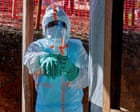
WHO director general Tedros Adhanom Ghebreyesus washes his hands at the Evangelical Medical Center. Photograph: Gradel Muyisa Mumbere/ReutersFive patients have recovered and four were to be discharged on Sunday, after the earlier discharge of the other patient, the WHO chief said. The organisation has recorded 906 suspected cases and 223 suspected deaths in the DRC. Authorities in neighbouring Uganda have confirmed nine cases and one death.
Fighting between rival armed groups in the mineral-rich Ituri region has complicated relief efforts, prompting Ghebreyesus to call for a ceasefire, saying: “No cause, no conflict, no grievance is worth condemning innocent people to death from a preventable disease.”
Burials and tears as Ebola outbreak continues to spread in DRC – in picturesRead moreBrazilian health authorities said they are monitoring two patients for possible Ebola infection in São Paulo and Rio de Janeiro. A 37-year-old man from DRC “exhibited symptoms such as fever, meeting the definition of a suspected case” of Ebola, the São Paulo state government said in a statement on Saturday. The health department in Rio de Janeiro state meanwhile reported that it had activated safety protocols after a man from Uganda showed “viral symptoms such as cough, chills and diarrhoea”.
The outbreak – which the WHO has declared a public health emergency of international concern – is the 17th recorded Ebola epidemic in the DRC. The disease was first identified in the central African country in 1976 and has an average death rate, across all outbreaks, of 50%.
Health officials and aid workers have complained they lack basic supplies such as masks. Medical aid donated by the European Union reached Ituri last week and the US announced $80m (£60m) in additional aid, raising its total commitment to $112m.
The Evangelical Medical Center, one of the facilities at the forefront of the response to the Ebola outbreak Photograph: ReutersThe Africa Centres for Disease Control and Prevention said national incident systems must be activated rapidly and that investments in pandemic preparedness must become permanent.
Jean Kaseya, the organisation’s director general, said in the Financial Times on Sunday that international support was vital and most effective when it aligned with the strategies of African institutions and African governments. “Africa’s response to Ebola must be defined by Africa itself,” he wrote.
The medical charity Médecins Sans Frontières (MSF) warned on Saturday that the disease’s spread was deeply alarming and that never before had so many cases been recorded so soon.
MSF teams were “witnessing a response that has not yet caught up to the rapid spread of the epidemic”, said the organisation’s deputy director, Alan Gonzalez. “The reality today is that nobody knows the true scale and severity of this outbreak. New suspected cases are being reported daily, yet hundreds of samples remain untested.”
Explore more on these topicsShareReuse this content‘Every health facility said they were full’: alarm over rapid spread of Ebola in DRC
23 May 2026WHO puts Ebola outbreak death rate at ‘huge’ 30-50% as chief arrives in DRC
2d agoEbola: US ban on travellers from DRC, Uganda or South Sudan ‘not the solution’
21 May 2026‘Among the things he feared most was death’: the doctors and nurses dying on the Ebola frontline
4d agoAs WHO sounds alarm over Ebola in DRC, what can be learned from previous outbreaks?
19 May 2026US building Ebola quarantine center in Kenya for Americans amid outbreak
4d agoSpread of Ebola in DRC ‘outpacing’ response efforts, warns WHO
6d agoWHO considers use of experimental vaccines as Ebola cases and deaths rise in DRC
19 May 2026‘It’s heartbreaking’: panic in eastern DRC over return of Ebola
18 May 2026Today in FocusAre we heading for another Ebola crisis? – podcast
22 May 2026