If you get Global News from Instagram or Facebook - that will be changing. Find out how you can still connect with us.
2:11 WHO seeking more information from Russian health authorities following death of lab technician The death of a Siberian lab technician has health officials around the world on high alert. Questions continue to persist around the exact cause of death, given she worked at a plague research institute. Health reporter Katherine Ward has more.Russian authorities told the World Health Organization (WHO) Tuesday that “no cases of plague” have been recorded in the Irkutsk Oblast region of Siberia, according to the UN health agency, after reports that a lab worker had died of possible pneumonic plague.
However, the WHO says Russian officials have not yet told the agency what the pathogen that killed the lab worker is.
“WHO is aware of media reports that a laboratory worker in Irkutsk oblast, in the Russian Federation, died of suspected pneumonic plague, and that nearly 200 of her contacts were under medical observation and being tested,” the WHO said.
“On 3 October, WHO asked the Russian authorities under the International Health Regulations (IHR) for any further information they had, so we could assess the risk. The IHR asks countries to respond within 24 hours acknowledging WHO’s request and then provide additional public health information within 48 hours.”
The statement continued: “The Russian authorities replied on 6 October and told WHO that the woman’s illness first looked like a typical acute respiratory viral infection, and that no case of plague has been recorded in Irkutsk, either in her or in anyone else.”
“WHO has requested additional information from Russia on which pneumonia-causing pathogen led to the woman’s death. WHO is following the situation closely, keeping other countries informed, and ready to support the Russian authorities if they ask.”
2:05 Russian plague: What we know about suspected case linked to lab worker’s deathThe update comes hours after Russian health officials said a full range of preventive measures had been carried out — including tracing of the deceased woman’s contacts, medical monitoring and lab tests.
Get weekly health news
Receive the latest medical news and health information delivered to you every Sunday. By providing your email address, you have read and agree to Global News' Terms and Conditions and Privacy Policy.“Test results showed no presence of dangerous infectious disease pathogens in any of the contacts,” said the note from Russian authorities, which was relayed to The Associated Press by WHO.
The Public Health Agency of Canada told Global News Monday evening that “at this time, no risk to Canada has been identified” and that it was “closely monitoring the situation.”
- Eva Marie Saint, Oscar winner and star of ‘On the Waterfront’ dead at 102
- Why did Christa Pike’s attempted execution fail? What medical experts say
- Christa Pike is conscious and speaking after failed execution, lawyers say
- Israel mourns Oct. 7 attacks as Palestinians in Gaza live in ruins of war
The lab worker, a 28-year-old woman, died at a hospital in Shelekhov, a town just outside the city of Irkutsk. Its mayor said earlier this week that the hospital was placed under quarantine, and officials from Russia’s national public health watchdog travelled to the region.
On Monday, Irkutsk Oblast Gov. Igor Kobzev did not identify the illness but said it was a suspected case of “a particularly dangerous infection,” later calling it “pneumonia of unknown etiology,” the Associated Press and Reuters reported.
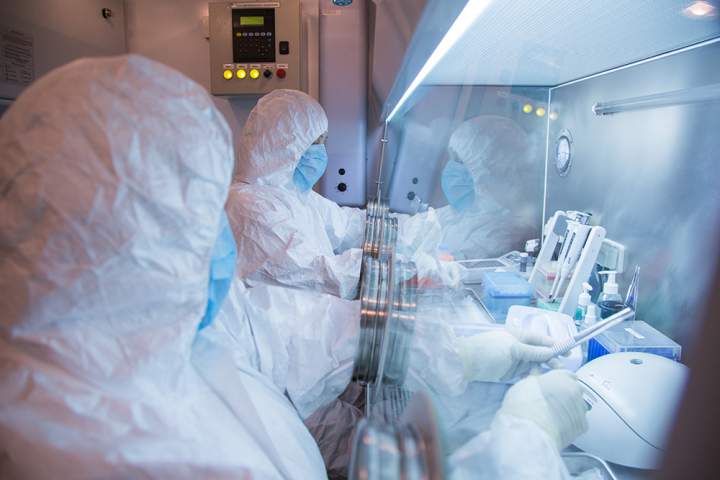
WHO spokesman Christian Lindmeier told a UN briefing on Tuesday that the institute where the woman worked “studies dangerous pathogens,” including plague in a part of Siberia where the disease “occurs naturally in wild animals.”
He said Russian officials have not yet asked for WHO experts to deploy to Russia, which had determined that health risks were moderate-to-low for Irkutsk; a low risk for the Russian Federation as a whole; and very low for the WHO European region.
U.S. President Donald Trump said on Monday that he was watching the situation.
U.S. Secretary of State Marco Rubio urged Russian authorities to share more information.
“Maybe there’s nothing there. Maybe it’s bigger than we thought. We don’t know,” he said at a news conference in Iceland. “We’re watching it very closely, and I think the whole world is watching it very closely.”
Canadian Health Minister Marjorie Michel said on Monday that there is “no risk for Canada.”
–with files from the Associated Press and Global News’ Katherine Ward
Add Global News as a Preferred Source on Google to see more of our stories in your search results.
Journalistic standards Report an error © 2026 Global News, a division of Corus Entertainment Inc.