Ibrahim Mahama has dug through the ruins of post-colonial Ghana, sorted through the ashes of its ancient history, picked through the industrial detritus, the corporate waste, the piles of rubbish, and found something pretty unique: hope.
Ibrahim Mahama, pictured at the Barbican Centre, London, in 2025. Photograph: Christian Cassiel/Barbican CentreSit on one of the Asante stools in his circular Parliament of Ghosts and you can almost feel a new future being worked out right in front of you. It’s the first installation in this huge exhibition at the Fondation Cartier in Paris, and it sums Mahama up pretty neatly. He’s looking at the collapse of the Ghanaian government in 1966, the way the hope of the post-colonial project was crushed in a military coup, and he’s looking at ancient Ghanaian history, at the empires that fell centuries ago and the way colonialism tore them to shreds. But he’s not lamenting any of them. He’s not mourning. Instead, he’s reclaiming them, asking how things can be rebuilt, how we can move forwards by learning from the past.
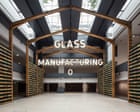
And he does it over and over. In 2024 he bought an old bottle factory – a symbol of industry and its collapse. He’s rebuilt it here, in the centre of Paris. Its steel roof beams, rusted and crumbling, reach up to the ceiling, its walls are lined with thousands of green bottles in Coca-Cola, Schweppes, Kool and Club Minerals crates. It’s a whole history of manufacturing, of commerce in West Africa post-independence. Not left to rot, but rebuilt and reconfigured into something new.
Not left to rot, but rebuilt and reconfigured into something new … Parliament of Ghosts by Ibrahim Mahama. Photograph: Benoit FougeirolNearby, he’s taken some of those bottles and piled them around a collection of local pottery. The industrial meets the artisanal, two lost arts creating a new one.
But this huge show isn’t really about Mahama, it’s about the people around him. Most of the work here is by nine other artists and collectives. Mahama runs three art centres near Tamale in Ghana, giving time, space and opportunities to local artists. Their work is given priority here, alongside art by his mentors and collaborators. He’s taken this massive exhibition opportunity and used it as a chance to celebrate his community. It’s almost as if he’s trying to make the rest of us feel bad.
Way up on the top floor, a long scroll of jute and bark by Dorothy Akpene Amenuke undulates across the floor. If it looks like Mahama’s work, it should: she was his art teacher back in 2013. Knowledge, and the past, gets reconfigured and reshaped once again.
Nearby, the wall of a farmhouse has been built by artist and architect Courage Dzidula Kpodo out of red earth clay, a material lost as modernism brought in concrete. Now, historic methods become a kind of resistance, a symbol of tradition’s ability to endure.
skip past newsletter promotionFree newsletter |WeeklySign up to Art Weekly
Your weekly art world round-up, sketching out all the biggest stories, scandals and exhibitions
after newsletter promotion
Historic methods as a kind of resistance … an artwork from Ibrahim Mahama’s The Harvest Season, Fondation Cartier, Paris. Photograph: Benoit FougeirolThose core ideas get repeated through pretty much every presentation here. Influential 97-year-old photographer James Barnor captures the communities around Mahama in large format, grainy Polaroids. Gideon Appah’s hazy, dream-like paintings imagine fictional Ghanaian youths staring out to sea, congregating on beaches in utopian, idealised visions of the country’s past. Some of the works are absolutely stunning, like Peter Doig and Noah Davis transported to Accra.
The best work, appropriately enough, isn’t by one artist but a collective. On the top floor, a bunch of lumpy, surreal sculptures of birds, bodies and men wrestling bulls is by the Congolese Plantation Workers Art League (CATPC). Each one is made of chocolate, sculpted in the DRC but poured into moulds in Amsterdam. Everything they make from selling the art goes towards buying back land confiscated in the early 20th century by the Lever Brothers, who we now know as Unilever. The work is a whole conversation about global trade taking place in sculptural form, an act of resistance and reclamation through chocolate.
This exhibition is essentially an ambitious, ultra-idealistic group show of West African art. It is art exhibition as political utopianism. Which is great, even if not everything in it is good. And the real draw is Mahama, with his archival approach to monumental installation art, and it’s a shame to not get a load more of it.
Mahama has sacrificed himself for the greater good, basically. But this collaborative approach is the point: he’s saying collective action, community, togetherness, that’s how we’ll build a future. It might sound a bit cloying and earnest, but then you see the results, you see the art and the ideas, you see the community and the hope and the idealism and you eventually say: “Get me a one-way ticket to Accra. I’m in.”
Ibrahim Mahama: The Harvest Season is at Fondation Cartier, Paris, from 22 October to 28 February