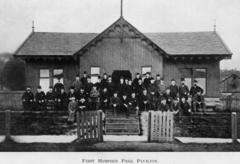
The site of the original Hampden Park, considered to be the world's first international football stadium, has earned protected status from Historic Environment Scotland.
Fears were raised last year that the grounds on Kingsley Avenue in Glasgow's southside could eventually be turned into flats because of the closure of the bowling club which was based on the land.
This meant the area could become available for commercial use or redevelopment, to the dismay of campaigners. They argued that the original Hampden - which hosted internationals and Scottish Cup finals from 1873-1883 - should be celebrated.
HES has now designated it a scheduled monument in recognition of its place in football history.
The aim of a scheduled monument is to preserve significant sites in Scotland as much as possible in the form they have been passed down to people today.
Glasgow Football TourRemains of the original football stadium were confirmed at Kingsley Avenue following an archaeological excavation in 2021Remains of the original football stadium - where Scotland famously routed England 5-1 in 1882 - were discovered following an archaeological excavation at the site in 2021.
When Queen's Park built the stadium, Scottish teams usually played on converted cricket pitches, such as the West of Scotland ground in Partick where Scotland and England played the world's first international in 1872.
The Hampden ground has long been considered the first stadium where many of the aspects now common to a football stadium - such as grandstands, turnstiles and season tickets for entry - originated.
Dara Parsons, head of designations at HES, said: "It feels timely to recognise the central role that Scotland played in the development of the sport, and the place of First Hampden within that story.
"The remains of the pavilion at the first Hampden are a link to the earliest days of football in Scotland, and its importance to, and impact on, communities. It is a monument to our national game and to the origins of the modern football stadium."
National Library of ScotlandA sketch of the dressing room at the first Hampden, from Free Kicks at Football magazine which appeared in 1882The decision followed a public consultation which showed support for the designation.
Parsons added: "We'd like to thank everyone who took time to take part in our consultation and share their valuable contributions.
"We had a great response, and we are looking to continue that engagement over the summer where we will be asking people to suggest important football heritage sites from across the whole of Scotland for us to investigate."
The original ground was replaced by the second Hampden Park in 1884, which was followed by the third version of the stadium - in Mount Florida - in 1903.
Hampden Bowling Club took over the original stadium's land in 1905 but closed earlier this year.
More than 8,000 scheduled monuments are currently spread across Scotland.
Among the most recent scheduled monuments are gun emplacements and anti-invasion defences from World War Two.
The monuments are of all types, including prehistoric burial mounds, Roman forts, early Christian carved stones and industrial mills.
Campbell RamageThere were concerns the land could be re-developedOriginal Hampden must be saved, says National Trust for Scotland
Could the first international football stadium become flats?
The day Scotland hosted the first football international
Listed buildingsGlasgowRelatedStudy funded to save historic railway works site
Future of historic priory secured after £235k fund
'A crumbling mini-Hogwarts right on our doorstep'
More from the BBC13 hrs agoTrain delays due to signalling fault near Glasgow Central
Network Rail says engineers are on site and working to fix the problem.
13 hrs ago20 hrs agoGlasgow's newest art mural unveiled on tenement building
20 hrs ago2 days agoGlasgow City Council leader Susan Aitken to step down
The leader will formally leave her role in September after Glasgow hosts the Commonwealth Games.
2 days ago2 days agoGlasgow will see phased rollout of 20mph roads from June
2 days ago4 days ago'Eye can see you': What's behind the new graffiti craze in Glasgow?
In the past few years a series of murals showing eyes have popped up across the West of Scotland.
4 days ago