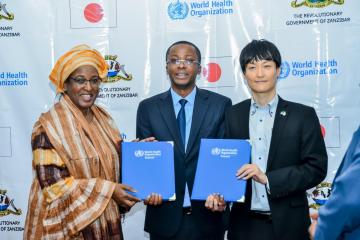
Zanzibar — The Revolutionary Government of Zanzibar, through the Ministry of Health and the Zanzibar Malaria Elimination Programme (ZAMEP), in collaboration with the World Health Organization (WHO), SORA Technology of Japan, and the Ifakara Health Institute (IHI), officially launch the Smart Drone Technology for a Malaria-Free Future in Zanzibar project, an innovative initiative aimed at accelerating malaria elimination efforts through the use of artificial intelligence and drone technology.
Funded by the Government of Japan, the project will pilot the use of AI-powered drone technology for biolarviciding within the framework of Larval Source Management (LSM) in selected shehias of Kati District, Zanzibar. The initiative supports Zanzibar’s ongoing efforts to strengthen integrated vector management and eliminate malaria transmission.
"This will be the first time Zanzibar will be implementing a malaria elimination approach that combines both advanced technology and community participation. For many years, there have been challenges with malaria, but in Zanzibar, it is below one percent. Now with this technology and community involvement, we believe we are going to write history by becoming malaria-free and be recognized globally as a territory without malaria transmisson" said Dr Miraji Mngereza Mzee, Permanent Secretary, Ministry of Health, Zanzibar.
The project introduces advanced drone and AI innovations developed by SORA Technology to improve the identification and management of mosquito breeding sites, enabling health teams to gain access to once difficult to access areas. Using aerial mapping of high-risk larval habitats, entomological monitoring to identify malaria-transmitting mosquito species, and predictive mapping to enable precise targeting of breeding habitats.
“We commend the Government of Zanzibar and the Ministry of Health through the Zanzibar Malaria Elimination Programme (ZAMEP) for their strong leadership and sustained commitment to malaria elimination. Zanzibar’s achievement in maintaining malaria prevalence at 0.04 pecent demonstrates what is possible through sustained investment, partnership, and innovation,” said Dr Ndoungou Salla BA, head of WHO liaison office in Zanzibar.
“We also sincerely thank the Government of Japan for its generous support and continued partnership in advancing impactful and innovative health solutions. This initiative reflects the power of collaboration, bringing together government leadership, WHO’s technical expertise, Japanese innovation, and research excellence to accelerate progress toward a malaria-free Zanzibar.”
Under the initiative, the Ministry of Health through ZAMEP will provide strategic leadership, regulatory coordination, and oversight of implementation to ensure integration of drone-based larval source management into national malaria control systems. WHO will provide overall leadership and coordination to ensure strategic alignment, technical quality, and effective collaboration among partners. SORA Technology will deploy the drone systems while supporting local capacity building and data-driven implementation.
To strengthen evidence generation and inform future programmatic decisions, the Ifakara Health Institute (IHI) will support the monitoring of entomological indicators, assessment of feasibility and cost, and documentation of lessons learned. Evidence generated through the project will compare drone-based and conventional larviciding approaches in terms of effectiveness, operational efficiency, and feasibility in reducing mosquito breeding and malaria transmission risk.
The official launch marks an important milestone in Zanzibar’s malaria elimination journey, reinforcing government ownership and accountability, and positions Zanzibar as a regional leader in adopting technology-driven approaches to address public health challenges.
About the Project
The Smart Drone Technology for a Malaria-Free Future in Zanzibar project is a collaborative initiative between the Ministry of Health Zanzibar through ZAMEP, the World Health Organization (WHO), SORA Technology of Japan, and the Ifakara Health Institute (IHI), funded by the Government of Japan. The project seeks to generate evidence on the use of AI-powered drone technology for malaria vector control to support Zanzibar’s malaria elimination agenda.
Click image to enlarge For Additional Information or to Request Interviews, Please contact: Sarah MujuliziCommunication Assistant
WHO Country Office, United Republic of Tanzania
Tel: +255 750 306676
Email: sarah.mujulizi [at] who.int (sarah[dot]mujulizi[at]who[dot]int)

