US military says it hit dozens of Iranian sites in strikes on Monday while UN chief warns that a return to full-scale fighting would be ‘catastrophic’
LIVE Updated 2m agoYohannes LoweMon 13 Jul 2026 04.39 EDTFirst published on Mon 13 Jul 2026 04.07 EDTShareKey events- 12m agoWhat are the state of US-Iran talks?
- 33m agoIran launches attacks on American military facilities in Bahrain and Kuwait after fresh US strikes
Iran launches attacks on American military facilities in Bahrain and Kuwait after fresh US strikes
Iran’s Revolutionary Guards said this morning they targeted American military facilities in Bahrain and Kuwait, destroyed radar systems in Oman and struck fuel tanks and ammunition depots at Prince Hassan air base in Jordan as part of its retaliatory strikes against the US.
Jordan said a few hours ago that it intercepted and downed four missiles fired from Iranian territory, while Kuwait’s military said it was intercepting “hostile aerial targets” in the country’s airspace.
The strikes marked an escalation in the recent tit-for-tat attacks between the US and Iran as Tehran seeks to assert sovereignty over the strategic strait of Hormuz, which it sees as its biggest leverage in negotiations with Washington.
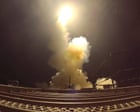
Explosions at an unknown location following what US Central Command (Centcom) said were strikes on Iran. The screengrab was taken from a video released on 12 July 2026. Photograph: US Central Command/ReutersThe Iranian attacks on US-allied countries across the region came in retaliation to overnight US strikes on “dozens” of Iranian sites, including air defence systems, radar sites, missile and drone equipment and small boats.
“The strait of Hormuz is a vital maritime corridor for global trade,” the US military’s Central Command said. “Iran does not control it.”
But Iran’s Revolutionary Guards, which controls the country’s ballistic missile arsenal, rejected the US statement, saying the strait “is our territory” and it would not allow Washington’s “illegal interference in it”.
Iran and the US are nearly midway through the 60-day period of an interim deal that was supposed to set-up talks for a permanent end to the war launched by the US and Israel in late February.
Instead, it has devolved into a series of attacks over the strait, through which one fifth of the world’s oil and gas usually flows, and its future.
The US president, Donald Trump, suggested last week that the interim deal in the war was “over”. But mediators – including Pakistan, Qatar and Egypt – have continued efforts to reach a final agreement.
Cargo ships anchoring near the strait of Hormuz off the UAE’s eastern coast on Sunday. Photograph: AFPTV/AFP/Getty ImagesIn other key developments:
The US said it had struck Iran early on Sunday after the IRGC fired on a Cyprus-registered container ship they claimed was sailing an “unauthorised route” through the strait of Hormuz.
According to state media, the IRGC then said they had hit a second vessel, accusing it of “violating regulations”.
A short time later, US Central Command said its forces had carried out a round of strikes against Iran, attacking at least 140 targets.
Iran launched missiles and drones at its Gulf neighbours yesterday in retaliation to US strikes and announced the closure of the strategic strait of Hormuz until further notice.
Donald Trump later rejected Iranian claims to have closed off the strait, insisting it was open to commercial traffic even though the US-run Joint Maritime Information Center said traffic was transiting the narrow waterway at “reduced levels”. Trump said US forces were keeping the strait open by force.
- 12m agoWhat are the state of US-Iran talks?
- 33m agoIran launches attacks on American military facilities in Bahrain and Kuwait after fresh US strikes
Oil prices jumped again on Monday as the US and Iran traded their latest attacks, with Brent crude, the global benchmark wholesale oil price, rising 4.2% to $79.18 a barrel in early London trading.
Jefferies analyst Mohit Kumar said:
For now, we remain hopeful that both parties would return to the negotiating table and traffic would start to flow through the strait. We are not looking for oil prices to go back to the March highs.
You can keep up with all the latest market reaction in our business live blog here:
Oil price jumps over 4% and gold slides as the US and Iran trade attacks –business liveRead moreShare12m ago04.29 EDTWhat are the state of US-Iran talks?
Julian BorgerA US-Iranian memorandum of understanding (MoU) signed on 17 June extended a ceasefire in the war by 60 days to allow the restoration of trade through the strait of Hormuz and create breathing space for talks on Tehran’s nuclear programme and sanctions relief, the main points of contention between Iran and the west.
Apart from some indirect technical talks, those negotiations have failed to materialise, and fighting has continued between Israel and Hezbollah in Lebanon, which was supposed to be covered by the agreement.
The MoU started to unravel when Iran attacked three commercial vessels last Monday as they were crossing the strait along a southern route next to the Omani coast that the Iranians said they had not approved. This drew US missile attacks in response, beginning almost a week of tit-for-tat exchanges.
Tehran is determined that any long-term settlement in the region recognises its control over the strait, which it seized soon after the US-Israel attack on Iran in February.
On Sunday, Mohsen Rezaee, a senior adviser to Iran’s supreme leader, Mojtaba Khamenei, was quoted in state media as saying: “This strategic passage is more important than dozens of atomic bombs, and the Islamic Republic of Iran will protect it.”
Trump restarts war with Iran and plays nice(ish) with Nato | Politics Weekly AmericaShare17m ago04.24 EDTThe deputy governor of Isfahan province said one person has been killed and seven others injured in a US attack on a military base in the Iranian city of Nain, according to a report in Iran’s Mehr news agency which we have not been able to independently verify.
Share23m ago04.17 EDTIn a series of social media posts this morning, Oman’s interior ministry said sirens were being activated and urged residents to head to the nearest safe place and await further instructions.
As we mentioned in the opening post, Iran’s Islamic Revolutionary Guard Corps said earlier that it had attacked radar systems in Oman as part of its counter strikes against the US.
ShareUpdated at 04.17 EDT33m ago04.07 EDTIran launches attacks on American military facilities in Bahrain and Kuwait after fresh US strikes
Iran’s Revolutionary Guards said this morning they targeted American military facilities in Bahrain and Kuwait, destroyed radar systems in Oman and struck fuel tanks and ammunition depots at Prince Hassan air base in Jordan as part of its retaliatory strikes against the US.
Jordan said a few hours ago that it intercepted and downed four missiles fired from Iranian territory, while Kuwait’s military said it was intercepting “hostile aerial targets” in the country’s airspace.
The strikes marked an escalation in the recent tit-for-tat attacks between the US and Iran as Tehran seeks to assert sovereignty over the strategic strait of Hormuz, which it sees as its biggest leverage in negotiations with Washington.
Explosions at an unknown location following what US Central Command (Centcom) said were strikes on Iran. The screengrab was taken from a video released on 12 July 2026. Photograph: US Central Command/ReutersThe Iranian attacks on US-allied countries across the region came in retaliation to overnight US strikes on “dozens” of Iranian sites, including air defence systems, radar sites, missile and drone equipment and small boats.
“The strait of Hormuz is a vital maritime corridor for global trade,” the US military’s Central Command said. “Iran does not control it.”
But Iran’s Revolutionary Guards, which controls the country’s ballistic missile arsenal, rejected the US statement, saying the strait “is our territory” and it would not allow Washington’s “illegal interference in it”.
Iran and the US are nearly midway through the 60-day period of an interim deal that was supposed to set-up talks for a permanent end to the war launched by the US and Israel in late February.
Instead, it has devolved into a series of attacks over the strait, through which one fifth of the world’s oil and gas usually flows, and its future.
The US president, Donald Trump, suggested last week that the interim deal in the war was “over”. But mediators – including Pakistan, Qatar and Egypt – have continued efforts to reach a final agreement.
Cargo ships anchoring near the strait of Hormuz off the UAE’s eastern coast on Sunday. Photograph: AFPTV/AFP/Getty ImagesIn other key developments:
The US said it had struck Iran early on Sunday after the IRGC fired on a Cyprus-registered container ship they claimed was sailing an “unauthorised route” through the strait of Hormuz.
According to state media, the IRGC then said they had hit a second vessel, accusing it of “violating regulations”.
A short time later, US Central Command said its forces had carried out a round of strikes against Iran, attacking at least 140 targets.
Iran launched missiles and drones at its Gulf neighbours yesterday in retaliation to US strikes and announced the closure of the strategic strait of Hormuz until further notice.
Donald Trump later rejected Iranian claims to have closed off the strait, insisting it was open to commercial traffic even though the US-run Joint Maritime Information Center said traffic was transiting the narrow waterway at “reduced levels”. Trump said US forces were keeping the strait open by force.
- US-Israel war on Iran
- Middle East crisis live
- Iran
- Trump administration
- Strait of Hormuz
- US foreign policy
- Israel
- Middle East and north Africa