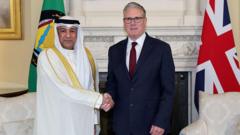
The UK has struck a trade deal with a group of six Gulf states which it says will be worth £3.7bn to the economy.
The government said the deal with Oman, Bahrain, Kuwait, Oman, Qatar, Saudi Arabia, and United Arab Emirates (UAE) will remove an estimated £580m a year in tariffs from British exports to the region once fully implemented.
It also said it will make it easier for British firms to expand and partner in the Gulf, which will support jobs.
However, rights groups have criticised the lack of detail on human rights and labour protections in the deal.
Meanwhile, the Conservatives, which began the negotiations for the deal when in government, said it was "another major Brexit opportunity" which Labour risks "throwing away" because what it sees as Labour's pro-EU stance.
British products that will have tariffs removed include cheddar cheese, butter and chocolate.
The deal between the UK and the Gulf Cooperation Council (GCC) states marks the third trade agreement struck by Prime Minister Sir Keir Starmer's government, after deals with India and South Korea.
It is also the first deal between a G7 country and the GCC.
Starmer said the deal was "a huge win" for British workers and businesses.
Working people "will feel the benefits in the years ahead through higher wages and more opportunities".
Business and Trade Secretary Peter Kyle said: "At a time of increased instability, today's announcement sends a clear signal of confidence – giving UK exporters the certainty they need to plan ahead."
Chancellor Rachel Reeves said the agreement was "proof we are backing British firms to compete and win globally".
"This agreement is good for jobs, good for industry and ultimately good for consumers."
However, rights group Trade Justice Movement has said the deal "poses serious risks to human rights, labour protections, and climate action".
It raised concerns about the GCC's record of restricting press freedom, using the death penalty, and being high producers of greenhouse gas emissions because of their six countries' oil industries.
"Any deal must reflect sustainability, equity, and human rights commitments, rather than prioritising economic gains at the expense of fundamental values," it added.
UK sets target to boost steel making and cut imports
Bentleys and Scottish salmon to benefit from UK-South Korea trade deal
Higher tariffs likely this week, says US Treasury
CompaniesTradeBrexitRelatedSupermarkets hit back over pressure to cap price of milk, bread and eggs
UK waters down new Russian oil sanctions as fuel prices rise
Faisal Islam: Why a full HS2 line could still be built despite the latest fiasco
More from the BBC2 days agoBurnham pledges not to 're-run' Brexit arguments
The potential leadership challenger says he is not proposing the UK considers rejoining the EU.
2 days ago4 days agoLabour leadership jostling puts Brexit back under political spotlight
4 days ago5 days agoTrump and Xi conclude 'very successful' talks but few deals confirmed
There were plenty of choreographed ceremonies but no trade breakthroughs after the two-day visit.
5 days ago8 days agoHow the Trump-Xi summit could set superpower relations for many years to come
Trump's whirlwind visit to China is the most significant for years - but will it bear fruit?
8 days ago11 May 2026'Britain at the heart of Europe': How Starmer's plans are going down in the EU
Sir Keir Starmer pledged to rebuild the UK's relationship with Europe in a defiant speech on Monday.
11 May 2026