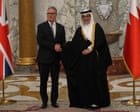
Keir Starmer has struck a trade deal with six Gulf states in what he described as a “huge win” for British business, ending four years of talks led by four different prime ministers.
The deal will offer £3.7bn worth of opportunities for exporters – double the original estimates – particularly in the food and luxury car sectors but also defence, aerospace, hospitality and other services, the government said.
It also provides the prime minister with a much-needed political window to show that the government is still capable of performing and concluding deals despite the turmoil and possible challenge to his leadership in the wake of the UK’s local elections.
But Starmer faced immediate criticism the deal did not include a chapter on human rights despite complaints of a “values free” deal a year ago.
Tom Wills, the director of the Trade Justice Movement, said the omission was “especially alarming given the severe human rights abuses across the Gulf region, including torture, forced labour, discrimination and the silencing of dissent”.
It is understood the government did not seek a human rights chapter as it views political channels as the best place to raise these issues.
The National Farmers’ Union (NFU) of England and Wales said it was the best agricultural deal since the UK left the EU, after it was able to see off demands to lower poultry standards.
The British Chambers of Commerce (BCC) said it would create new business for firms in financial services, energy, construction, professional services, education, hospitality and technology.
William Bain, the head of trade policy at the BCC, said the deal offered great potential to expand trade in the region and would be “vital for tens of thousands of UK firms”.
It is the third trade deal concluded by Starmer following pacts with India and South Korea. Tariffs will be removed from 93% of British goods sold in the six countries in the Gulf Cooperation Council (GCC) trading bloc of Saudi Arabia, Kuwait, Oman, Qatar, United Arab Emirates and Bahrain.
Among the sectors that will face zero tariffs are food, medical equipment, defence, aerospace and advanced manufacturing.
Exporters into the GCC faced a blanket tariff of 5%, with some other products facing higher duties. Cheddar cheese was taxed at 6% while chocolate and biscuits were at 15% and 10%. Cars were also taxed at 5%.
As part of the deal, the Gulf states have also agreed to allow UK firms to store data outside the region for the first time.
UK services, which account for 80% of the UK economy, will get “guaranteed access” to business in the six states, the government said.
The president of the NFU, Tom Bradshaw, who had been concerned that the government would make concessions on standards of poultry from the gulf, welcomed the deal for farmers.
“We think this is probably the best negotiation we had for agriculture. We are really happy,” he said.
Starmer said: “Today’s agreement is a huge win for British business, and for working people, who will feel the benefits in the years ahead through higher wages and more opportunities.”
Peter Kyle, the business secretary, said he was proud that the UK was the first G7 country “to secure a modern and ambitious trade deal with the GCC”.
Gulf states export few goods outside petrochemicals to the UK, which are already sold into the country duty-free, but the deal will be seen as a huge political affirmation for the countries for investors in both directions.
It will also underline the importance of Gulf investment in the UK in everything from Heathrow airport (part-owned by Qatar) to Newcastle Football Club (part-owned by Saudi Arabia).
Wills said the inclusion of chapters on investor protection was concerning as it could pave the way for lawsuits in the UK should government policy change, for example on a third runway at Heathrow.
Paul Nowak, the general secretary of the Trade Unions Congress, which had raised concerns about human rights provisions in the deal a year ago, said it was “disappointing” a deal had been signed “despite their appalling record of human right and workers’ rights”.